Français
 English
 Deutsch
 Български


Madsen light machine gun, model 1904
Description
Madsen light machine gun, model 1904.
Manufacturer / main description
Madsen light machine gun, model 1904.
Calibre: 6.5 mm, 7 mm, 7.92 mm Mauser, 8 mm Lebel or .303 British
Length: approx. 110–115 cm
Weight: approx. 8–9 kg depending on version and calibre
Feed system: top-mounted curved magazine, approximately 25 to 30 rounds depending on calibre
Date of design: late 19th century, adopted around 1902
Manufacture: Denmark – Dansk Rekylriffel Syndikat, Copenhagen
Operation: short recoil with oscillating locking system
Research and descriptions prepared with the help of an AI assistant (ChatGPT-5). Typological inaccuracies or errors may remain. Illustration reconstructed from the original object.
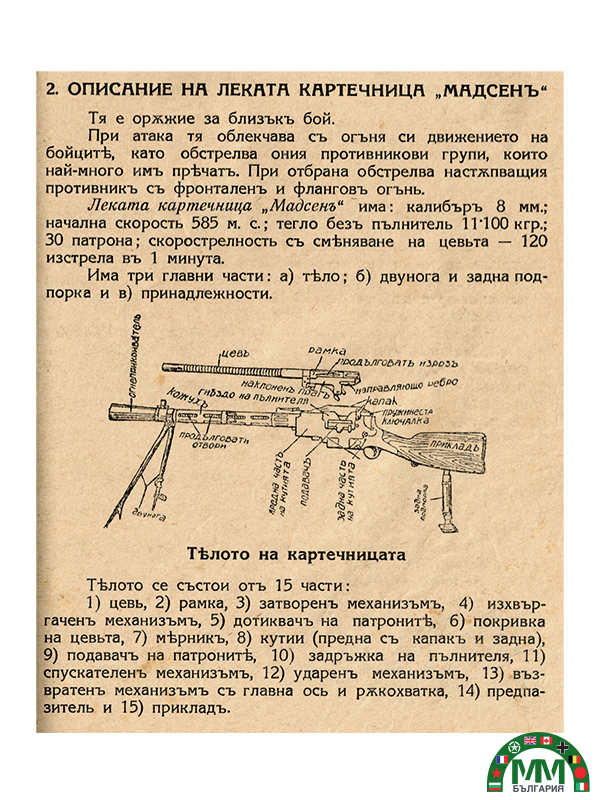
The Madsen light machine gun was one of the first portable light machine guns adopted on a large scale in the early 20th century. Designed by Danish engineers Vilhelm Madsen and Julius Rasmussen, it is characterized by its curved magazine placed above the weapon, feeding cartridges by gravity, and by its complex internal mechanism using an oscillating locking system. The barrel is surrounded by a perforated jacket for cooling, and the weapon is generally fitted with a bipod for prone firing. The Madsen light machine gun could be served by a gunner and an assistant loader, providing mobile automatic support at infantry-section level. Its robust design and reliability earned it exceptional international distribution. The weapon was produced in many calibres, including 6.5 mm, 7 mm, 7.92 mm Mauser, 8 mm Lebel and .303 British, in order to meet the needs of different armies. The Madsen was one of the first light machine guns to be exported on a large scale. It was adopted or used by many countries in Europe, Latin America and Asia. Its success was due to its portability, relatively high rate of fire and reliability, qualities sought by armies in the early 20th century. Bulgaria adopted the Madsen light machine gun in the early 20th century as part of the modernization of its armament before the Balkan Wars of 1912–1913.
Bulgarian Madsens were generally chambered for the 7.92 mm Mauser cartridge, compatible with the standard rifles of the Bulgarian army. These weapons were used in Bulgarian infantry units as light automatic weapons during the Balkan Wars and then during the First World War, alongside other machine guns such as the Maxim. The Madsen provided mobile automatic support to infantry sections, increasing firepower during assaults or in the defence of positions. After 1918, despite the restrictions imposed by the Treaty of Neuilly, a number of Madsen light machine guns remained in service in the Bulgarian army, particularly for training and for equipping certain units. They were gradually replaced during the 1930s by more recent models. The Madsen light machine gun occupies an important place in the history of modern armament. It represents one of the first truly effective portable automatic weapons, foreshadowing the central role that light machine guns would play in 20th-century military doctrine.
Madsen light machine guns in the Bulgarian army.
At the beginning of the 20th century, Bulgaria rapidly modernized its armament in order to strengthen its military capabilities before the Balkan Wars and the First World War. Among the automatic weapons acquired was the Danish Madsen light machine gun, produced by Dansk Rekylriffel Syndikat (DRS) in Copenhagen. At the time, the Madsen was one of the first truly portable light machine guns available on the international market, and it was exported to many countries. The exact origin of the Bulgarian Madsens remains debated. According to arms historian Jean Huon, Bulgaria acquired Madsen model 1904 light machine guns in 1915, chambered for the 8 × 50R Mannlicher cartridge, a round also used by the Austro-Hungarian army. Another hypothesis, mentioned in some studies and specialist discussions, refers to the purchase by Bulgaria of a batch of around 660 Madsens from an earlier Brazilian contract. These weapons, originally manufactured for Brazil in 7 × 57 Mauser calibre and returned to Denmark for modification, may ultimately have been resold to Bulgaria during the war. After various complications linked to maritime transport in wartime, the weapons may have been landed in Germany, notably at Lübeck, and then sent by rail to Sofia. The exact calibre of the Madsens used by Bulgaria remains uncertain in some sources. Several possibilities are mentioned: 7 × 57 Mauser, the original calibre of the Brazilian contract; 7.92 × 57 Mauser, compatible with German weapons used by the Bulgarian army; and 8 × 50R Mannlicher, as indicated by Jean Huon. It is possible that some weapons were rebarrelled or modified to adapt them to the ammunition available in the Bulgarian army or among the forces allied with the Central Powers. Discussions among arms historians show that the sources are sometimes contradictory. Some hypotheses suggest that Madsens from the Brazilian contract were intercepted by Germany and used on the Western Front in 1915, while others argue that they were captured Russian weapons in 7.62 mm Mosin calibre, later modified for the German 7.92 mm Mauser cartridge. These divergences illustrate the difficulties involved in documenting arms transfers during the First World War, a period in which many contracts were modified or diverted because of logistical and political constraints. Despite these uncertainties, it is established that the Madsen light machine gun was present in the inventory of the Bulgarian army during the First World War. It supplemented the automatic armament of infantry units alongside Maxim machine guns, providing a more mobile automatic weapon for section support. Even if the exact origin of the batches and their calibre remain partly debated, the Madsen is an attested element of Bulgarian armament during the First World War, reflecting the diversity of Bulgaria’s sources of weapons supply during the conflict.
Videos
Linked products

Photo bulgare section FM Madsen
See details
Carte postale bulgare section FM Madsen
See details