Français
 English
 Deutsch
 Български

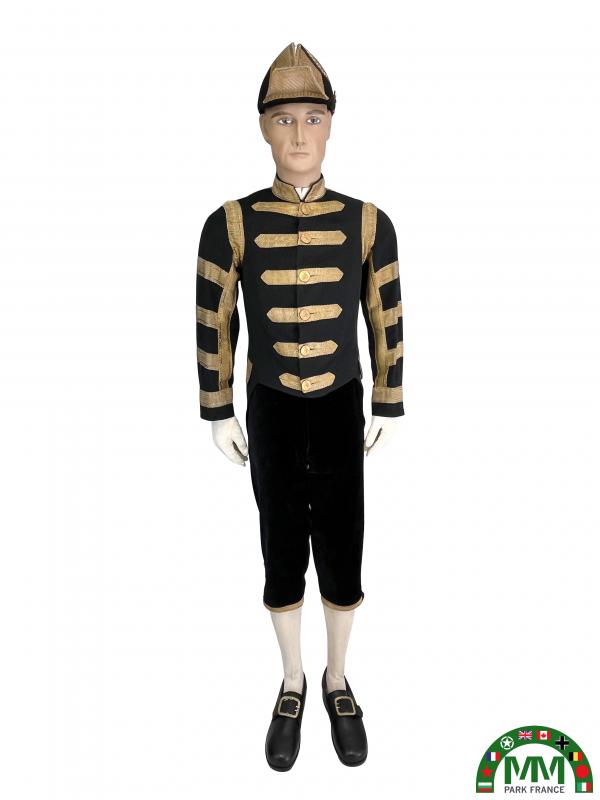
Complete Bulgarian palace staff footman uniform
Description
Complete Bulgarian palace staff footman uniform.
Manufacturer / main description
Complete Bulgarian palace staff footman uniform.
Palace footman livery
Bulgaria – Royal Household –
Period: reign of Ferdinand I, circa 1887–1918.
Ensemble comprising a braided bicorne, a black cloth frock coat decorated with gold braid, a shirt, knee breeches, stockings and buckle shoes. The gilt-metal buttons bear the Saxon arms and the dynastic motto “Fideliter et Constanter” (“Faithfully and Constantly”), reflecting the origins of the Saxe-Coburg-Gotha dynasty. This outfit was worn by footmen or palace servants of the royal palace during ceremonies, receptions and formal service. Its style, inspired by the great European courts, perpetuates the dress traditions of the 18th and 19th centuries.
Research and descriptions prepared with the help of an AI assistant (ChatGPT-5). Typological inaccuracies or errors may remain. Illustration reconstructed from the original uniform.
Grand livery of a palace footman
Reign of H. M. Ferdinand I of Bulgaria (1887–1918).
Complete court livery ensemble comprising a braided service bicorne, a full-livery frock coat, a shirt with stiff standing collar, cloth knee breeches, a pair of stockings and a pair of buckle shoes. The buttons bear the royal arms and the motto of the House of Saxony. Rare and remarkable court livery set that belonged to the staff of the Royal Palace of Bulgaria under the reign of His Majesty Ferdinand I (1861–1948), sovereign prince of Bulgaria from 1887 and then Tsar of the Bulgarians from 22 September 1908. This outfit was worn by footmen attached to the interior service of the Royal Household during official ceremonies, receptions, state banquets, audiences or movements of the sovereign. The ensemble is made from very dark blue wool cloth, almost black, enriched with substantial gilt-metal braid. Flattened bicorne in black felt with raised wings, trimmed with gilt-metal braid and a central cockade. This type of headgear, inherited from the tradition of 18th-century European courts, remained in use in royal and imperial households until the early 20th century. Full-livery frock coat in midnight-blue cloth, fastening at the front with six gilt buttons. The chest is decorated with six horizontal brandenburgs embroidered in gilt-metal braid ending in points. The sleeves are richly decorated with broad horizontal bands of gold braid recalling the livery cuffs used in the courts of Central Europe. The shoulders carry braided counter-epaulettes. The fitted cut, characteristic of the Belle Époque, emphasizes the silhouette while retaining elements inherited from 18th-century tradition. The stamped gilt-metal buttons bear the arms of the Royal House of Saxe-Coburg and Gotha. Around the Saxon shield appears the motto “Fidelity and Constancy” (Fideliter et Constanter), surmounted by a royal crown. This motto is that of the Order of the Crown of Rue (Hausorden der Rautenkrone), a dynastic order of the Kingdom of Saxony. The presence of these buttons directly reflects the Saxon origins of Ferdinand I, a member of the Catholic branch of Saxe-Coburg-Gotha-Koháry. White shirt with rigid standing collar, in keeping with court dress at the end of the 19th century. Short breeches in dark blue cloth falling below the knee. This type of breeches, preserved in court liveries after disappearing from civilian dress, is a direct inheritance from 18th-century aristocratic usage. White or cream stockings rising above the knee. Low black leather shoes decorated with metal buckles. Their design is inspired by models worn by servants of the great European households since the classical period. Function and use. Palace footmen performed service in the royal apartments, received and announced visitors, served at table during banquets, accompanied the sovereign and members of the royal family, participated in ceremonial audiences and performed honorary service during court festivities and ceremonies. Their uniform was an essential element of monarchical prestige and formed part of the staging of royal power. Historical context. After his election to the Bulgarian throne in 1887, Ferdinand of Saxe-Coburg-Gotha set out to provide the young Bulgarian monarchy with etiquette and ceremonial inspired by the great European courts, especially those of France.
The Bulgarian Royal Household thus adopted an extremely elaborate system of liveries and uniforms, reflecting the Germanic origins of the sovereign and his pronounced taste for splendour. In 1908, when Ferdinand proclaimed the full independence of the country and assumed the title of Tsar of the Bulgarians, the organization of the Court reached its height. These liveries remained in use until the reign of Boris III, with only minor modifications. Effects belonging to the staff of the Bulgarian Royal Household are extremely rare. The political upheavals following the abolition of the monarchy in 1946, as well as destruction and successive dispersals, explain the near disappearance of the uniforms and liveries of the Royal Palace. Complete sets preserved in private hands or public collections are exceptionally few.
Upon his accession in 1887, Ferdinand I undertook to organize the Bulgarian Royal Court according to the customs of the great European monarchies. Raised in a cosmopolitan environment, he received an education deeply influenced by his mother, Princess Clémentine d’Orléans (1817–1907), daughter of King Louis-Philippe I of the French. A strong-willed woman attached to the traditions of the House of Orléans, Clémentine transmitted to her son a taste for etiquette, ceremony and monarchical representation. The organization of the Bulgarian Royal Household thus reflects a synthesis of the great European traditions. While Ferdinand’s Saxon origins appear in the dynastic emblems, notably the buttons bearing the arms of Saxe-Coburg-Gotha and the motto “Fidelity and Constancy”, the liveries of the palace staff show a strong affinity with the practices of the Court of the Tuileries and the House of Orléans. The cut of the frock coat, the wearing of knee breeches, white stockings and buckle shoes, as well as the preservation of dress forms inherited from the 18th century, recall the great French liveries perpetuated in European sovereign houses until the beginning of the 20th century. After the proclamation of the kingdom’s independence in 1908 and Ferdinand’s accession to the title of Tsar of the Bulgarians, court etiquette reached its full development. The liveries of the palace staff remained in use under Boris III, with only minor adaptations, until the abolition of the monarchy in 1946.
Displayed at MM Park France
Exhibition: “In the Service of Ferdinand I”