Français
 English
 Deutsch
 Български

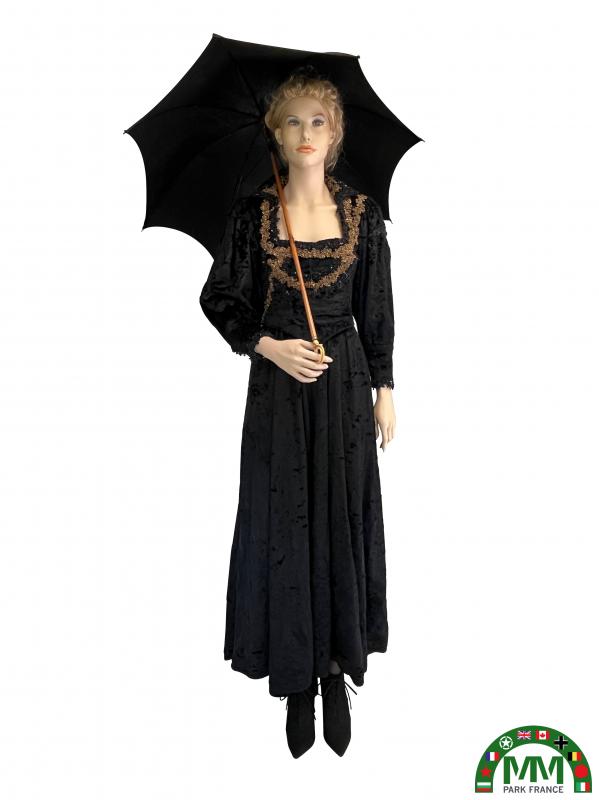
Complete outfit of Anna de Grenaud, née Stanchova
Description
Complete outfit of Anna de Grenaud, married name Stanchova.
Manufacturer / main description
Complete outfit of Anna de Grenaud, married name Stanchova.
Dress attributed to Anna de Grenaud de Saint-Christophe (1861-1955).
This black dress in embossed velvet (or devoré velvet), decorated with brown-gold lace trimmings, presents an elegant silhouette evoking the fashion of the late 19th century and the early years of the 20th century. The black parasol harmoniously completes the ensemble, strengthening the aristocratic atmosphere and recalling the distinction of court ladies and the upper bourgeoisie of the Belle Époque. Anna de Grenaud de Saint-Christophe was lady-in-waiting to Princess Clémentine d'Orléans, then first lady-in-waiting to Princesses Marie-Louise of Bourbon-Parma and Eleonore Reuss of Köstritz at the royal court of Bulgaria. Wife of the Bulgarian diplomat Dimitar Stanchov, she was among the notable figures of the young Bulgarian monarchy and left valuable memoirs on court life and European diplomacy between 1887 and 1915.
Research and descriptions written with the help of an AI assistant (ChatGPT-5). Inaccuracies or typological errors may remain.
Digital colorization of a historical photograph.
Anna de Grenaud de Saint-Christophe (1861-1955)
Lady-in-waiting to the princesses of Bulgaria and privileged witness to an emerging court. Born in 1861 into an old noble family from Savoy, Anna de Grenaud de Saint-Christophe grew up in a deeply French environment. Her father, Alexandre Joseph Bonifort de Grenaud, later served at the court of the future Bulgarian ruler Ferdinand of Saxe-Coburg. Her childhood unfolded between Savoyard aristocratic traditions and an education marked by French culture.
When Prince Ferdinand of Saxe-Coburg became ruler of Bulgaria in 1887, his mother, Princess Clémentine d'Orléans, settled in Sofia to support her son in building the young Bulgarian monarchy. Anna de Grenaud then entered her service as lady-in-waiting and accompanied her in this exceptional undertaking. At that time, Bulgaria had only recently regained its autonomy after several centuries of Ottoman rule. There was practically no court tradition comparable to those of Paris, Vienna or Saint Petersburg. Princess Clémentine and her French entourage therefore played an essential role in creating etiquette, diplomatic customs and monarchical prestige. Anna stood at the heart of this founding work.
In the service of Princess Clémentine d'Orléans.
Among all the personalities surrounding Ferdinand, Princess Clémentine was probably the most influential. Daughter of King Louis-Philippe I, she brought to Sofia the political experience and refinement of the French monarchy. Anna became one of her close collaborators. Contemporary testimonies show that Clémentine regarded her with genuine affection. At Anna's marriage to the Bulgarian diplomat Dimitar Stanchov in 1889, the princess played almost a maternal role toward the young woman. King Ferdinand himself announced the engagement at court, a sign of the esteem she enjoyed. This period allowed Anna to observe closely the birth of the modern Bulgarian state and the efforts made to give Sofia the brilliance of a European capital.
First lady-in-waiting to Princess Marie-Louise.
In 1892, Ferdinand married Princess Marie-Louise of Bourbon-Parma. After this marriage, Anna de Grenaud was appointed first lady-in-waiting to the new sovereign. This function was one of the most prestigious at court. It involved organizing the princess's daily life, accompanying her on official journeys and managing numerous ceremonies. Anna thus accompanied Marie-Louise during trips abroad and took part in establishing the ceremonial practices of the Bulgarian court. Her husband, Dimitar Stanchov, was then secretary to the sovereign; the couple even lived for a time in the royal palace in Sofia. The premature death of Marie-Louise in 1899 deeply marked the court. Anna nevertheless remained attached to the royal family and continued her role in the sovereign's entourage.
At the side of Tsarina Eleonore.
After the years spent at her husband's diplomatic posts in Romania, Austria and Russia, Anna returned to the forefront when Ferdinand married for a second time, to the German princess Eleonore Reuss of Köstritz. She was then chosen to become first lady-in-waiting to the new tsarina. Eleonore was known for her devotion, her charitable works and her personal commitment to the wounded during the Balkan Wars. Anna again found herself at the heart of court life, this time in a monarchy that had become much more stable and recognized on the European stage. Her experience, her knowledge of diplomatic customs and her loyalty to the dynasty made her a respected figure in the palace.
Diplomat's wife and memoirist.
Alongside her court duties, Anna accompanied her husband in his diplomatic career. She stayed in several European capitals and took an active part in Bulgarian diplomatic life. Contemporaries emphasized the positive influence she had on her husband and her remarkable sense of social relations. She also became the mother of several children, including the famous Nadejda Stancioff, a pioneer of Bulgarian diplomacy.
A precious memory of the Bulgarian court. Anna de Grenaud left memoirs entitled Palace and Diplomatic Memories, 1887-1915, an exceptional source on the beginnings of the Bulgarian monarchy. In them she recounts the personalities she met, the customs of the court and the major diplomatic events of her time. She died in 1955 at the age of 94 and was one of the last direct witnesses to the creation of modern Bulgaria. Her life links the French nobility of Savoy, the court of the Orléans and the history of the Bulgarian monarchy.
Displayed at MM Park France
Exhibition: "In the Service of Ferdinand I"